
 Discussion
Zevaskyn (prademagene zamikeracel) for epidermolysis bullosa
Last updated May 7, 2025, by Marisa Wexler, MS
 Fact-checked by José Lopes, PhD
What is Zevaskyn for epidermolysis bullosa?
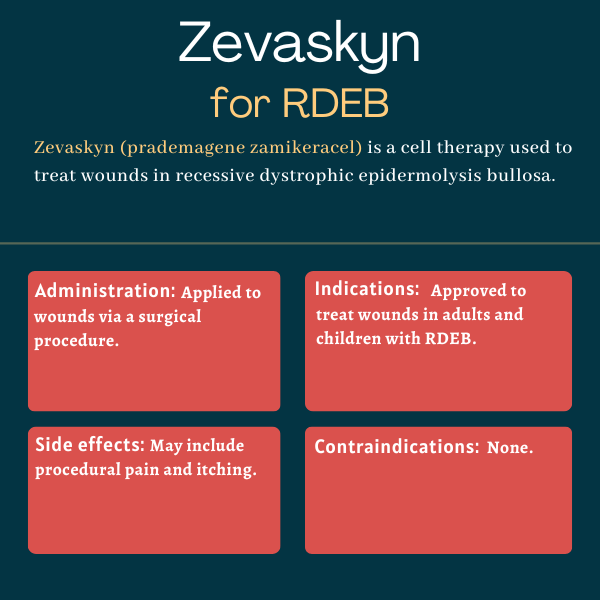
Zevaskyn (prademagene zamikeracel) is a surgically administered cell therapy approved to treat wounds in adults and children with recessive dystrophic epidermolysis bullosa (RDEB). It was developed by Abeona Therapeutics and during development was known as pz-cel or EB-101.
RDEB is caused by mutations in the COL7A1 gene, which encodes instructions to make a part of type VII collagen, a protein that helps skin maintain its structure. Lacking functional type VII collagen, people with RDEB have fragile skin that’s prone to chronic wounds that don’t heal efficiently. Zevaskyn works by collecting a patient’s skin cells and engineering them to carry a healthy version of the COL7A1 gene. The modified cells are grown on a thin sheet, which is then grafted onto a patient’s wounds to promote healing.
Therapy snapshot
Scroll horizontally to view all columns -->
| Brand name: | Zevaskyn |
| Chemical name: | Prademagene zamikeracel |
| Usage: | Used to treat wounds in RDEB |
| Administration: | Applied surgically to wounds |
Who can use Zevaskyn?
Zevaskyn was approved by the U.S. Food and Drug Administration (FDA) in April 2025. The therapy is indicated for the treatment of wounds in adult and pediatric patients with RDEB.
The prescribing information for Zevaskyn does not list any contraindications.
How is Zevaskyn administered?
After skin cells are collected from a patient, they are shipped to a specialized facility that modifies the cells and grows them into Zevaskyn sheets. The sheets are then shipped directly to the qualified treatment center where Zevaskyn will be administered. The therapy is applied to wounds via a surgical procedure that is typically done under anesthesia.
After Zevaskyn is administered, the treated area should be left undisturbed for five to 10 days. The treated area should be kept dry until the gauze on the back of the Zevaskyn product falls off, which should occur within two or three weeks after application.
Zevaskyn in clinical trials
FDA approval of Zevaskyn was based on data from a Phase 3 clinical trial called VIITAL (NCT04227106), conducted in nine adults and two children with RDEB.
- The VIITAL study’s main goals were to see if Zevaskyn increased the number of chronic wounds healing by at least 50%, and eased wound pain as rated on a scale from 0 to 10. Results showed that, after six months, 81% of Zevaskyn-treated wounds healed by at least 50%, whereas only 16% of wounds receiving standard wound care showed such healing. Additionally, 16% of Zevaskyn-treated wounds (but none of the controls) healed completely, whereas pain scores were reduced by a mean of more than three points for wounds receiving Zevaskyn but only by a mean of less than a point in untreated wounds.
Side effects of Zevaskyn
The most common side effects of Zevaskyn are:
- pain related to the surgical procedure used to apply the therapy
- itching.
Allergic reactions, including severe reactions known as anaphylaxis, can occur with Zevaskyn. If an allergic reaction occurs, it should be treated according to standard procedures. Symptoms of an allergic reaction to the therapy may include:
- itching
- swelling
- hives
- trouble breathing
- runny nose
- watery eyes
- nausea.
Because Zevaskyn is made using biological material derived from humans and cows, there is a theoretical risk that infectious agents could be transmitted through the therapy. All material used to make Zevaskyn is monitored for viruses, bacteria, and other infectious agents, which minimizes but does not completely eliminate the risk of infection.
Zevaskyn works by using a modified virus to insert a healthy copy of the COL7A1 gene into a patient’s cells. Because the therapy changes DNA, it’s theoretically possible that it could lead to mutations that could set the stage for cancer to develop. Individuals treated with Zevaskyn should be monitored for cancer throughout the rest of their life, and any cases of cancer should be reported to the therapy’s developer.
Epidermolysis Bullosa News is strictly a news and information website about the disease. It does not provide medical advice, diagnosis, or treatment. This content is not intended to be a substitute for professional medical advice, diagnosis, or treatment. Always seek the advice of your physician or other qualified health provider with any questions you may have regarding a medical condition. Never disregard professional medical advice or delay in seeking it because of something you have read on this website.
Related articles
-
Discussion
-
 Discussion
-
 Discussion
-
 Discussion
-
 Discussion
-
 Discussion