
17 years later, I’m still learning how to navigate EB — and parenthood
I’m increasingly trying to anticipate what might happen with my teenage son
Written by |

“We need to put sunscreen on you,” I said again to Jonah, my (sometimes stubborn) teenager who lives with epidermolysis bullosa (EB), as he stood out in the sun because he was shivering under the shade of the Shibumi.
As Jonah ages and his skin doesn’t blister quite as much thanks to the dupilumab injections he’s receiving through a clinical trial, he’s experimenting more and more with wearing fewer bandages. Although he has been going without arm bandages during the day for a year now, our long weekend trip to Ocean Isle Beach in North Carolina this past weekend was his first real trial with having his legs unbandaged.
Sunscreen is always a pain. Typically we use a safe zinc-based lotion cream to start the day. The problem with those is that they have to be rubbed in well. As you can imagine, that can be difficult to do on fragile, wound-dotted skin. When it’s time to reapply, lotion or zinc-based sunscreens are even more difficult if he’s sandy, sweaty, or wet. Rubbing it in then is not an option. Spray is better, but all the clear sprays we’ve found sting his wounds.

Unfortunately, due to not listening to his mother, Jonah did suffer a mild sunburn on his legs and shoulders. Even more unfortunately, this mild sunburn led to more fragile than usual skin, and an array of small dotted blisters in the burned areas. Bandaging those areas has been problematic because it seems the edges of the bandages cause more of the tiny blisters, creating a vicious cycle.
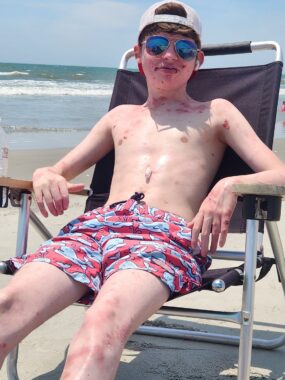
Jonah, after sunscreen was carefully applied, sits on the beach this past weekend at Ocean Isle Beach in North Carolina. (Photo by Patrice Williams)
The crazy thing about EB is that even after 17 and a half years of living with it, we’re still learning the risks, results, and ways of dealing with what it brings. When he began going without arm bandages during the day, we learned that his elbows are surprisingly fragile and get infected easily. When we have to bandage wounds on his shoulders, we’ve learned to adapt to the spots that can handle Mepitac, an “EB-safe” tape, and the areas of skin that can’t. His stomach rarely gets blisters, but his shoulders and neck almost always do.
And what’s true for Jonah may be the exact opposite for another child with EB, even one with the same or a very similar type.
I have known this truth about EB for years, of course, but with the thought of him possibly moving away a year from now to live on a college campus, the pressure to find out and figure out is mounting. Hypervigilance as a special needs mom is common, but I find more and more I’m trying to anticipate and preemptively fix what might possibly happen, knowing my time is running out.
The problem comes in Jonah wanting to lean on me as a crutch while also being incredibly annoyed that I’m “nagging” him. Granted, I’m equally annoyed at his lack of initiative in achieving independence while simultaneously aggravated that when I do make a suggestion, he argues with it or ignores it altogether. We are a hot mess.
Such is the plight of living with a rare disease. Nobody really knows, and it’s figure it out as you go.
And you need your mom’s help navigating it until, all of a sudden, you just want her to leave you the bleep alone.
Managing a rare disease is a lot like raising a teenager, actually. Nobody has all the answers, every person’s experience is different, there’s a lot of frustration and eye-rolling, and most of it is figured out one hard-learned lesson (and unsaid told you so) at a time.
Note: Epidermolysis Bullosa News is strictly a news and information website about the disease. It does not provide medical advice, diagnosis, or treatment. This content is not intended to be a substitute for professional medical advice, diagnosis, or treatment. Always seek the advice of your physician or other qualified health provider with any questions you may have regarding a medical condition. Never disregard professional medical advice or delay in seeking it because of something you have read on this website. The opinions expressed in this column are not those of Epidermolysis Bullosa News or its parent company, Bionews, and are intended to spark discussion about issues pertaining to epidermolysis bullosa.

Leave a comment
Fill in the required fields to post. Your email address will not be published.