
For National Family Caregivers Month, my son with EB shares his thoughts
A columnist interviews her teenager about his care experience
Written by |

For National Family Caregivers Month, I took the opportunity to interview my son Jonah about his care experience as a teenager living with epidermolysis bullosa.
PW: What’s the hardest part about needing caregivers as a teenager?
JW: I would say it just limits me in general. I’m always having to worry about nurses in everything I do, especially when it comes to planning things. They need to be able to get a full day’s work, but that makes it hard if I am wanting to hang out with friends or do anything on my own.
What’s something people don’t understand about what it’s like to need care?
It’s constant. It’s not just in the morning or just in the evening. It’s always something I have to think about and a huge component of my daily life. And it’s not just the time it takes. The psychological part of it is even worse — just having to consider EB and what it requires all the time.

What’s the best part about having your mom as one of your caregivers?
I’ve been through so many nurses through the years, but you’re always there. I can rely on you to be there. Also, you’re my mom, so it’s just different.
What’s the hardest part about having your mom be your caregiver?
Oh, that’s easy. You can’t get fired, so you can yell at me as much as you want. I can’t fire my mother.
Are there times when you want me to be your mom and not your caregiver?
Honestly, I want you to be my mom and not my caregiver for your sake more than mine. You have so much you have to do. I wish you had to do less. Like, you have a full-time job and you’re a mom, but you have to be a caregiver on top of all that.
What’s different about having a nurse care for you?
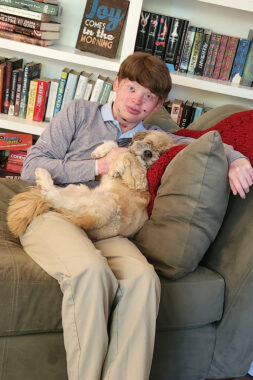
Jonah hangs out at home with his dog, Muggsy, waiting to be interviewed. (Courtesy of Patrice Williams)
Well, you didn’t ask for this, but they did. I love them, but it’s a job for them. I know they care about me, but a lot of the questions they have to ask are because they have to ask them for charting reasons. If I’m in pain, obviously they care that I’m hurting, but they also have to ask the details of where and how much because they have to chart why they are giving me pain medicine. With you, you can just empathize with me and be sad that I’m hurting without having to ask the diagnostic questions.
How has your need for privacy and independence changed as you’ve gotten older?
As I’ve gotten older, I definitely need more privacy and independence. I don’t want help doing everything. I try to do as much as I can on my own before letting anyone help. It’s also hard when we have to have a new nurse train because I don’t love random people coming into the house and having to be vulnerable with strangers.
What’s the best way for a caregiver to help you without making you feel like you’re being hovered over?
Believe me. I do know what’s best for me. I know what I need and need to be listened to.
What’s something caregivers do that makes you feel cared for beyond the physical tasks?
Both Clair and Jessi, my regular nurses, genuinely care about me and what’s going on in my life. They both follow my favorite sports teams so they can ask about them. Even when they’re not on shift, they check in on me. When they go on vacation, they send me pictures, and if I’m on vacation, they text to see if I’m having a good time. I definitely feel cared for beyond what they’re required to do.
When you think about your future, what do you hope caregiving and independence will look like?
Ideally, I’d like to not have a caregiver, but I don’t know yet what the future’s going to hold or if I’ll be able to live completely independently. Because I’ve never tried, it’s hard to know. I want to be as independent as possible.
If you could tell caregivers one thing that might help them better care for someone with EB, what would it be?
As kids get older and are able to communicate their needs, listen to them and do your best to empathize, even if you can’t completely understand. That goes a long way in building trust.
***
With each year, our story of living with EB becomes more Jonah’s and less mine. I’m always thankful when he shares his heart and words. For other interviews with Jonah, you can read my previous columns from 2020, 2022, and early 2026.
Note: Epidermolysis Bullosa News is strictly a news and information website about the disease. It does not provide medical advice, diagnosis, or treatment. This content is not intended to be a substitute for professional medical advice, diagnosis, or treatment. Always seek the advice of your physician or other qualified health provider with any questions you may have regarding a medical condition. Never disregard professional medical advice or delay in seeking it because of something you have read on this website. The opinions expressed in this column are not those of Epidermolysis Bullosa News or its parent company, Bionews, and are intended to spark discussion about issues pertaining to epidermolysis bullosa.


Leave a comment
Fill in the required fields to post. Your email address will not be published.